
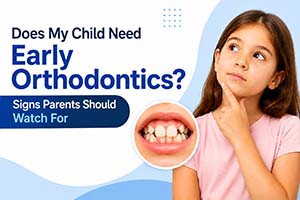
As a parent, you want to know whether your child’s smile is developing normally or whether early orthodontic care might be needed. Many orthodontic issues are easier to guide when children are still growing, which is why early evaluation can make a big difference.
At Pleasant Dental Euless, we often encourage parents to stay alert for early warning signs such as crowding, bite problems, mouth breathing, or thumb sucking. These changes do not always mean a child needs braces right away, but they are worth paying attention to.
Why early orthodontic evaluation matters
Early orthodontics, sometimes called interceptive orthodontics, focuses on identifying developmental issues before they become more serious. Because children’s jaws and teeth are still growing, orthodontists can sometimes guide development more effectively at a younger age.
The goal is not always to start treatment immediately. In many cases, an early exam helps determine whether your child should be monitored, treated now, or seen again later when more permanent teeth come in.
Many experts recommend that children have an orthodontic assessment by around age 7, since enough permanent teeth have usually erupted by then to reveal potential alignment concerns.
Signs your child may need early orthodontics
There are several signs parents can watch for at home. One of the most common is crowded or overlapping teeth, especially when adult teeth begin to come in and there does not seem to be enough space.
Another sign is bite misalignment. This can include an overbite, underbite, crossbite, or open bite, where the upper and lower teeth do not meet the way they should.
If your child has trouble chewing or biting food, that can also point to a problem with how the teeth are lining up. Children should be able to bite comfortably without shifting their jaw or avoiding certain foods.
Mouth breathing and snoring can also be clues. While these symptoms can have several causes, they sometimes appear alongside jaw or tooth alignment issues.
Thumb sucking or other prolonged oral habits may affect how the teeth and jaws develop over time. If the habit continues beyond the toddler years, it can contribute to protruding teeth or bite changes.
Parents should also watch for early or late loss of baby teeth. Losing baby teeth too soon or holding onto them for too long can sometimes signal that permanent teeth are not erupting in the right order.
Speech difficulties can also be a sign, especially if your child has trouble making certain sounds and there does not seem to be another obvious cause. In some cases, tooth position or jaw alignment may play a role.
Jaw shifting, clicking, or facial asymmetry may also be worth discussing with a dentist or orthodontist. These signs can suggest that the bite is not developing evenly.
Common signs to watch at home
Here is a simple checklist parents can use:
- Teeth that look crowded, rotated, or pushed forward.
- Upper and lower teeth that do not meet evenly.
- Frequent mouth breathing or snoring.
- Thumb sucking or prolonged pacifier use.
- Difficulty chewing, biting, or speaking clearly.
- Baby teeth falling out too early or too late.
- Jaws that shift, pop, or seem uneven.
If you notice one or more of these signs, it does not automatically mean your child needs braces. It does mean an orthodontic screening may be a smart next step.
What early orthodontic treatment can help with
Early orthodontic care can help guide jaw growth, create space for incoming teeth, and reduce the risk of more complicated treatment later. In some children, this early approach may help shorten future treatment or make it simpler.
Treatment may also help improve chewing function, speech development, and bite balance. When issues are addressed earlier, children may avoid worsening crowding or jaw problems as they grow.
That said, not every child needs immediate treatment. Some children simply need monitoring, while others may benefit from a short phase of treatment followed by a later phase when more permanent teeth are present.
What happens during an orthodontic visit
An early orthodontic visit is usually simple and child-friendly. The orthodontist or dentist will examine your child’s teeth, bite, jaw growth, and oral habits, and may take X-rays or photos if needed.
From there, they may recommend treatment, observation, or a follow-up visit later. This first evaluation is often more about planning than committing to braces right away.
At Pleasant Dental Euless, this kind of visit is an opportunity to catch small issues before they become bigger ones. It also gives parents clear guidance, which can reduce stress and confusion about timing.
When parents should schedule an exam
A good rule of thumb is to schedule an orthodontic evaluation by age 7, or sooner if you notice visible concerns like crowding, bite problems, or prolonged thumb sucking.
You should also book an appointment if your child complains about chewing, often bites their cheek or tongue, or seems to have difficulty closing their mouth comfortably. These can all be signs that the bite needs attention.
Even if your child seems too young for braces, an early check can still be valuable. It helps a dental professional decide whether development is on track or whether intervention may be helpful.
Helping your child feel comfortable
If your child does need early orthodontic care, the experience is often easier than parents expect. Many children adjust quickly when treatment is explained in simple, positive terms.
It helps to frame the visit as a way to keep their smile healthy and strong rather than something scary or painful. A calm, reassuring approach can make a big difference in how your child responds.
Parents can also reinforce healthy habits at home, such as discouraging thumb sucking, encouraging nose breathing, and keeping up with regular dental visits. These small steps can support orthodontic progress and overall oral health.
Conclusion
So, does your child need early orthodontics? The answer depends on their growth, bite, and oral habits, but warning signs like crowding, mouth breathing, bite problems, and delayed tooth loss are worth watching closely.
An early orthodontic evaluation can help detect concerns at the right time, giving your child the best chance for a healthy, confident smile. If you are in the Euless area, Pleasant Dental Euless can help you determine whether your child should be seen now or monitored for later.