
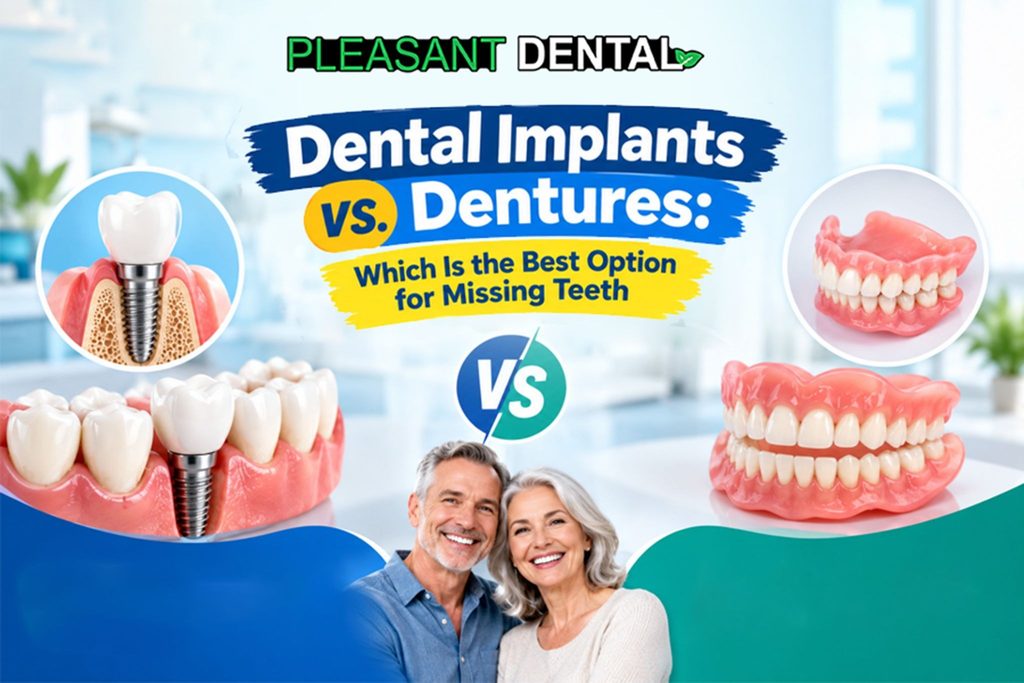
Choosing between dental implants and dentures ultimately depends on your individual health, budget, and long-term lifestyle goals. While dental implants function like natural teeth by fusing directly with the jawbone to preserve bone structure and provide permanent stability, they require sufficient bone density, surgical placement, and a higher upfront investment. Dentures, on the other hand, offer a non-invasive, faster, and more affordable solution, though they may require regular adjustments and adhesive over time. Evaluating the pros and cons of each option with your dentist will help you determine the safest, most comfortable path toward restoring both your function and your frame of mind. This guide compares both so you can have an informed conversation with your dentist.
Why Replacing Missing Teeth Matters
Leaving a gap unaddressed can cause problems over time. When a tooth is lost, the damage extends deep beneath the surface of your gums long before it is visually obvious. Without a complete arch, neighbouring teeth gradually tilt into the vacant gap, throwing off your natural bite alignment and creating hard-to-reach traps for plaque. Simultaneously, the unanchored section of the jawbone loses the essential biological stimulation provided by root pressure, causing the bone tissue to resorb and weaken over time. Addressing a missing tooth quickly halts this destructive domino effect, safeguarding your remaining teeth and maintaining your natural facial structure. Replacing missing teeth helps protect your remaining teeth, your bite, and your facial structure.
What Are Dental Implants?
A dental implant is a tiny titanium screw surgically embedded directly into the jaw. Over time, the surrounding bone grows tightly around the post through a process called osseointegration, creating a rock-solid foundation for a tailor-made crown, bridge, or fixed prosthesis. Because it anchors securely within the bone structure rather than resting on top of the gums, an implant provides the stability, biting force, and natural feel of a real tooth.
Advantages of implants:
• Stable, natural-feeling chewing and speaking
• Help preserve the jawbone
• Do not rely on neighboring teeth for support
• No adhesives or nightly removal for single-tooth implants
Drawbacks to consider:
• Higher upfront cost
• Treatment takes several months because the bone must heal
• Requires surgery and enough healthy bone, and some patients need a bone graft first
• Not ideal for everyone, including some people with uncontrolled diabetes, heavy tobacco use, or certain medical conditions
What Are Dentures?
Dentures are removable replacements for missing teeth. Full dentures replace an entire arch, while partial dentures fill in gaps and clip onto remaining teeth.
Advantages of dentures:
• Lower initial cost
• Shorter treatment timeline
• Usually no surgery required
• A reasonable option for people who cannot undergo implant surgery
• Can replace many teeth at once
Drawbacks to consider:
• Can limit food choices, especially sticky or hard foods
• Need daily removal and cleaning
• Do not stop bone loss, so they may need adjustments, relines, or replacement over time
• Some people find them less comfortable
Dental Implants vs Dentures: A Side-by-Side Look
| Factor | Dental Implants | Dentures |
| Stability | Fixed in the jawbone | Rest on gums, may shift |
| Comfort and feel | Close to natural teeth | Varies by fit |
| Jawbone health | Help preserve bone | Do not prevent bone loss |
| Upfront cost | Higher | Lower |
| Treatment time | Several months | Often weeks |
| Maintenance | Brush and floss like natural teeth | Daily removal and cleaning |
| Surgery | Yes | Usually no |
Middle Ground: Implant-Supported Dentures
If you need to replace many teeth, there is an option that combines both approaches. Implant-supported dentures snap onto a small number of implants, which makes them more stable than traditional dentures while costing less than replacing every tooth with an individual implant. Many patients who struggle with loose dentures find this a comfortable upgrade.
How to Decide
The best choice depends on your situation. Talk with your dentist about:
• Your oral health: Gum condition and jawbone density affect whether implants are possible.
• Your overall health: Chronic conditions, medications, and smoking can influence healing.
• Your budget: Compare the initial cost with long-term maintenance and replacement needs.
• Your timeline: Decide whether you need teeth replaced quickly or can wait for healing.
• Your priorities: Think about comfort, appearance, convenience, and how you like to eat.
Because every smile and lifestyle is unique, tooth replacement is never a one-size-fits-all decision. A solution that brings complete comfort and budget satisfaction to one person, like a removable denture, might not offer the permanent, fixed stability another patient prefers from dental implants. Navigating this choice comes down to weighing your personal priorities—whether that means prioritizing immediate convenience, long-term durability, or total structural support.
Dental Implants in Euless, TX and Denture Options Nearby
If you live in the Tarrant County area, an exam is the best first step. A dentist offering dental implants in Euless, TX can review your X-rays, check your bone and gum health, and explain which treatments suit you. Look for a practice that also provides dentures, since a provider who offers both options is more likely to recommend what fits your needs, not just what they happen to offer. Ask about the treatment timeline, total cost, payment options, and what follow-up care is included.
Questions to Ask at Your Consultation
• Am I a good candidate for implants?
• Would I need a bone graft or other preparation?
• What will the full process cost, and what does that include?
• How long will treatment take?
• How do I care for the replacement teeth?
• What are the alternatives if implants are not right for me?
The Bottom Line
Regardless of which path you choose, both solutions effectively restore your ability to eat comfortably, speak clearly, and smile with confidence.. Implants generally offer better stability and help preserve bone, but they cost more and take longer. Dentures are more affordable and faster, though they may need more adjustments. A personalized evaluation is the most reliable way to decide.